Showing posts with label poems. Show all posts

23 May 2010

Another one

The gift orbits us
For H, then and now

I searched the crevices of the chair,
putting my fingers where my eyes were reluctant to go,
and sat back on my heels
with two bent bookmarks
and an old pen with a tiny rose in its lid.

I’m telling you, I told you,
that chair has a throat and a stomach. If ever
I have it recovered, I will ask the upholsterers
to search for your rectangle of glittering stones.

And I will return it –
in two or twenty years’ time.
I know the worth of that now;
I look forward to it.

As well as to the next time I drive to you,
all of three minutes away;
one road linking our homes.
A dip and a slight climb
that takes me through sun shot off glass,
shadows loosed by walls;
often the single great plane of night.
Hard to imagine traversing such solidity,
effortless in practice.

It seems that much of my life,
this life I remember
after the one I inhabited as a child,
is being spent with you with me
or in my thoughts.

When your voice was remote
there was your handwriting;
the two so similar, fast flowing.
But now you’re here,
and though you say it may change any day,
we’ve slowed into deeper water:
it feels permanent.


(First published in New Contrast 149, Autumn 2010)

22 April 2010

Overlaps


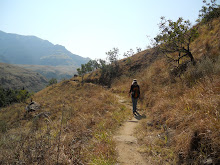
(This photo by Rico Schacherl. It and the others are from Nieu Bethesda, the Karoo, in which thoughts such as the ones in this post have ample space to breathe)

‘I break open stars and find nothing, and again nothing,
and then a word in a foreign tongue.’

George Steiner quotes these lines by Elisabeth Borcher in Language and Silence (1974, New York: Atheneum, p 51). Anne Michaels quotes the same lines as an epigraph to her poem ‘What the Light Teaches’ (Poems 2001, New York: Alfred A Knopf, p 117).

I’m intrigued by this kind of literary overlap. It’s not a coincidence; Steiner and Michaels are both speaking of language as traumatised by events like the Holocaust in the Second World War. ‘Because their language had served at Belsen, because words can be found for all those things and men were not struck dumb for using them,’ Steiner points out, ‘a number of German writers ... despaired of their instrument’ (p 51). (He acknowledges also that ‘the failure of the word in the face of the inhuman is by no means limited to German’ (p 51).) Michaels, too, refers to language – German, Polish, Russian – that has been stripped of its more humane meanings (her implication: by the Nazis), just the alphabet remaining the same, the victim’s language revealing only ‘the one who named him’ (p 124).

Behind these texts lies Theodor Adorno’s well-known injunction (which he later qualified) about the barbarism of the notion of poetry after an ‘event’ such as Auschwitz. Whether or not he would agree with the statement, Steiner does not suggest that writers stop writing; rather he wonders, in 1966, whether they are writing too much – people speak far too much and far too easily, he feels, ‘making common what is private’ and creating of their culture ‘a wind-tunnel of gossip’ (p 53). In his view, ‘silence is an alternative’ to this situation (p 54). Michaels, among many other poets and writers, chooses not to remain silent, and refuses to accede to the pressure that squeezes and twists language out of its ethical shape. For her, language can take a vitally recuperative form. Her conclusion in ‘What the Light Teaches’ is that language is ‘a country; home; family’; ‘for those who can’t read their way in the streets, / or in the gestures and faces of strangers, / language is the house to run to / ... when you have no other place’ (pp 128–9).

The overlap is also not a case of appropriation. Michaels’s research is meticulous; although she doesn’t list Steiner among her sources in the acknowledgements page of Poems (nor in the acknowledgements page of Fugitive Pieces, which deals slightly differently with the same theme), she may well have come across his reference to Borcher. But that’s not the point; Steiner and Michaels’s uses of Borcher’s poetry are independent and legitimate – I’m simply identifying their congruence as an interesting phenomenon in literature.


Here’s another overlap:

The concept of the ‘aha moment’ as used by Oprah is well known to her fans (not so surprisingly, there’s even been a court case over it). AS Byatt knows about it too: in an ‘aha experience’, she suggests, a ‘structure felt to be defective or inchoate suddenly appears formed and harmonious’ (Still Life 1985, New York: Simon & Schuster, p 260).

In Oprahdom, these moments are memorable, connect-the-dots moments when everything suddenly clicks into place.* For Byatt the moment occurs when a human being feels a relaxation, a ‘release’, of tension caused by desire (p 260). If someone is hungry, they will have an aha experience not through the final goal itself, not nourishment, say, but rather in the act of eating (p 260).

While Oprah and Byatt are not speaking of quite the same thing, in both cases it brings satisfaction.

* Among all the definitions of this concept on the internet, it's difficult to find the original


06 January 2010

What's out there so far

(Design reproduced from the original by Jesse Breytenbach, with her kind permission)


The eye of the mind, the eye of the heart

In moments of ecstatic illumination,
brief and rare, but memorable,
it can be pitch dark and it wouldn't matter.
Seeing becomes perceiving
and evidence becomes understanding.
You don't need your eyes for that;
you could walk blindfold through an unfamiliar room
stacked with crystal glasses and not break a thing.

Moments like those,
when they do occur,
seem so illuminating that they make you think you see
everything else just as clearly, for a while.
But they're deceptive
as the afterimage of a flash lighting up your retinas;
and before you know it,
you're once again clumsy even in broad daylight
and spilling secrets as if you were drunk.

(First published in Carapace 62, March 2007; and then in A Look Away Issue 7, Quarter 4, 2007)


After as is before

When you go,
silence will fall with the rain
so soft and heavy it's
evident only when a drop
strikes a leaf,
strokes each place in me that is yours,
landing on gestures that
have people pinpointing parallels that
we know for what they are;
such is the power of assumption.

When you go,
I will lose and find and lose again,
I will find and lose and find again
in a process I've learned
can be endured,
can be the reward of endurance.
One way, I am here because of you.
And I'll remain, in a way because of you.
We know each other for who we are;
such is the power of belief.

When you go,
you will have known, perhaps best,
that there'll be at once so much
and nothing more to be said.
And in the ceremony of tears I will
stand and feel your falling
with the silence,
with the rain;
and be forever traced,
borne and bereft.

(First published in New Contrast 142, June 2008)


The weak spot

There is a place for him in her heart.
A weak spot
like a sprained wrist that
years later
gives way under an impromptu handstand.

(First published in New Contrast 143, September 2008)


Rest for the third eye

I want the sleep I used to have
when the fall was shorter
and the rise longer;
supreme sense of comfort in each -
a taste craved by the mind.

Tongue stilled,
silence gained.

A shift
to which gravity is beside the point
and thus is neither plummet nor ascension
but something in between -
a kind of suspension.

Movement enacted by thought in the vast velvet sea.
A kind of meditation, humbly meant.

Yet I continue to lie awake.

(First published in New Contrast 147, Spring 2009)


At table we met

At worst, and rarely,
you reached down into my throat
and pulled me inside out,
spreading every visceral element on the table before you,
pointing and identifying,
presuming the past, pronouncing the future.

At best, and much more often,
you opened the curtains,
your hands warm as the sun,
your gaze fixed on me.
From you, I received the gift of successive awakenings to joy,
invaluable breakfasts.

Burned but simmering,
you frog-leapt over the present and into the future,
asking what if again and again,
with the false certainty that a question sometimes brings;
trying to create what you had imagined,
trying to capture what you had created.

You didn't want information,
you wanted to be spoon-fed.
Like a child with Asperger's,
for you each morsel had to be laid out on the plate just so,
else the entire meal was inedible;
the whole less than the sum of its parts.

This is the role we sometimes play:
to be another's mistake.
We cannot help but learn from the lesson ourselves,
and if we're lucky
there is good in the good and good even in the bad;
and though the fairytale ends in nothing like happily ever after,
what comfort there is
just in the after;
what nourishment there is
in successive simple meals.

(First published in New Contrast 148, Summer 2009)